

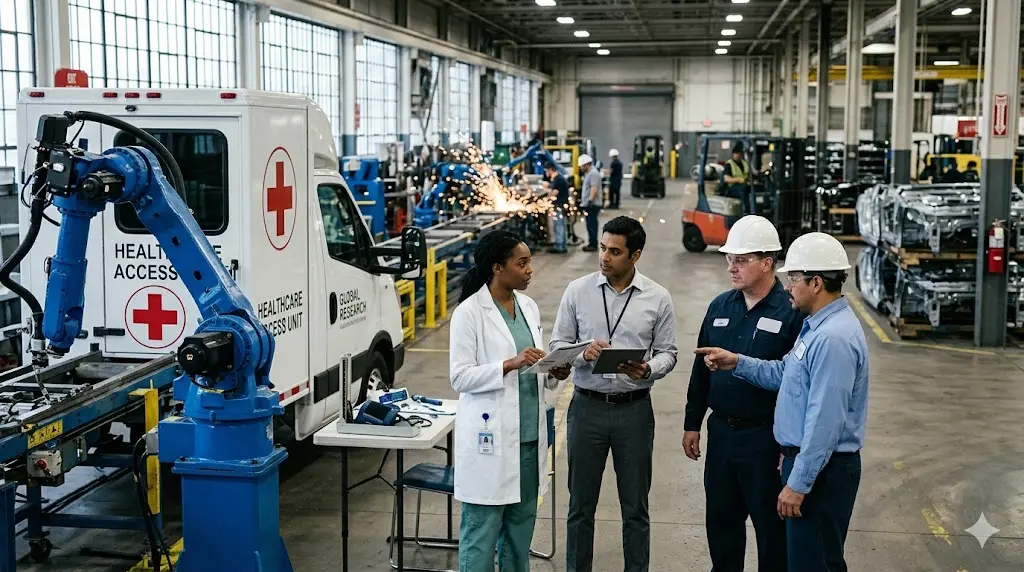
Healthcare access in the automotive industry has become a serious global workforce issue, especially as factories, supply chains, and logistics operations expand across different regions. Workers now expect more than wages and job security. They want affordable healthcare, mental health support, emergency care access, and safer working conditions.
At the same time, automotive companies are under pressure to reduce employee turnover, improve productivity, and protect worker wellbeing in an industry known for physical strain and long shifts. Here's the thing: organizations that invest in healthcare access often see stronger retention and better operational performance.
Global research on healthcare access in the automotive industry shows that employee wellbeing directly affects productivity, retention, safety, and workforce stability. Companies offering better healthcare support, mental health services, and preventive care programs are more likely to maintain skilled labor and reduce long-term operational costs.
What Is Global Research on Healthcare Access in the Automotive Industry?
Healthcare Access in the Automotive Industry: The availability of medical services, preventive care, mental health support, insurance coverage, and workplace wellness programs for employees working across automotive manufacturing, logistics, engineering, and dealership networks.
Global research on healthcare access in the automotive industry focuses on how automotive workers receive healthcare support across developed and developing markets. Researchers examine factory healthcare policies, occupational health systems, insurance availability, workplace injury management, and employee wellness initiatives.
What most people overlook is that healthcare access isn't just about hospitals or insurance cards. In automotive manufacturing, it also includes:
On-site medical facilities
Occupational injury prevention
Mental health counseling
Access to emergency treatment
Long-term physical rehabilitation
Preventive wellness screenings
A worker assembling vehicle components for 10 hours a day faces completely different healthcare challenges compared to an office employee. Repetitive strain injuries, respiratory exposure, heat stress, fatigue, and mental burnout are common concerns in automotive plants worldwide.
In my experience, many discussions around automotive innovation focus only on electric vehicles or automation. But workforce healthcare might quietly become one of the industry's biggest competitive advantages over the next decade.
Why Healthcare Access Matters
The automotive industry in 2026 looks very different from what it did even five years ago. Electric vehicle production, AI-driven manufacturing systems, and global supply chain pressures have changed workplace expectations dramatically.
Healthcare access now affects recruitment almost as much as salary packages.
Younger workers entering automotive jobs are asking direct questions about insurance, mental wellness support, paid medical leave, and flexible healthcare benefits. Companies that ignore these concerns probably won't keep skilled employees for very long.
Rising Physical and Mental Health Challenges
Automotive workers continue to deal with physically demanding environments. Assembly line repetition, night shifts, warehouse logistics, and production deadlines create health pressure that builds slowly over time.
Mental health has also become a growing issue.
A surprising number of workers report anxiety linked to production targets, job uncertainty caused by automation, and long overtime schedules. Some factories have started introducing counseling services and wellness programs not because they're trendy, but because burnout became too expensive to ignore.
Global Differences in Healthcare Access
Research shows major differences between regions.
Workers in Germany, Japan, and parts of Scandinavia often receive stronger occupational healthcare protections compared to workers in lower-cost manufacturing hubs where healthcare systems remain inconsistent.
That gap creates operational risks.
For example, a multinational automotive supplier operating factories across Asia, Europe, and Latin America may struggle with uneven workforce health outcomes because local healthcare access varies significantly.
One realistic example involves a parts manufacturer expanding into Southeast Asia. The company experienced higher absenteeism and injury recovery delays because nearby healthcare infrastructure couldn't support fast treatment access. After introducing mobile health clinics and private insurance partnerships, attendance and retention improved noticeably within a year.
That's the kind of practical change global research keeps highlighting.
Expert Tip
Companies that treat healthcare as a workforce investment instead of an expense often reduce hidden costs tied to absenteeism, production errors, and employee turnover. The savings don't always appear immediately, but they compound over time.
How Automotive Companies Are Improving Healthcare Access
Many automotive organizations are shifting toward proactive healthcare strategies instead of reacting only after injuries happen.
Some approaches are surprisingly simple.
Others require major structural investment.
How to Improve Healthcare Access in the Automotive Industry — Step by Step
1. Assess Workplace Health Risks
Companies first analyze common workplace injuries, stress patterns, and medical access gaps.
This might include ergonomic studies, employee surveys, injury tracking, or mental health assessments.
Without real workforce data, healthcare programs usually miss the actual problems.
2. Introduce Preventive Healthcare Programs
Preventive care is becoming more common in automotive workplaces.
Programs may include:
Routine health screenings
Vaccination drives
Fitness support
Nutrition guidance
Fatigue management education
Preventing illness is usually cheaper than dealing with long-term medical leave later.
3. Expand Mental Health Support
This area has grown fast over the last few years.
Automotive companies are increasingly offering:
Counseling services
Stress management workshops
Burnout prevention programs
Confidential therapy access
Here's the counterintuitive part: mental health support often improves factory productivity more than some expensive operational upgrades.
Employees who feel psychologically supported tend to make fewer mistakes and stay longer.
4. Improve Emergency Medical Access
Some automotive facilities now include on-site clinics or partnerships with nearby hospitals.
Fast response matters, especially in manufacturing environments involving machinery, chemicals, or repetitive physical tasks.
A delay of even one hour in medical care can affect recovery outcomes significantly.
5. Use Technology for Healthcare Access
Digital healthcare tools are changing things quickly.
Telemedicine platforms, wearable health monitoring devices, and AI-powered wellness tracking systems are becoming more common in large automotive organizations.
Remote healthcare access helps workers in isolated industrial zones where hospitals may not be nearby.
Expert Tip
Many companies invest heavily in automation while ignoring worker fatigue. In reality, even advanced production systems still depend on healthy people making accurate decisions every day.
The Connection Between Healthcare and Productivity
A lot of executives still separate workforce health from operational performance. That's probably outdated thinking.
Research consistently links healthcare access with:
Lower absenteeism
Higher retention
Better safety performance
Reduced production disruptions
Improved employee morale
Healthy workers generally sustain productivity more consistently than exhausted or untreated workers.
One automotive logistics company reportedly reduced sick leave rates after introducing preventive physiotherapy sessions for warehouse employees dealing with repetitive lifting injuries. The improvement wasn't dramatic overnight, but within several quarters the difference became measurable.
Small interventions can produce surprisingly large operational gains.
Healthcare Access and Supply Chain Stability
Here's something many reports barely mention: healthcare access also affects supply chain resilience.
When worker illness or injuries increase, production delays spread across suppliers, shipping operations, dealerships, and manufacturing timelines.
During recent global disruptions, companies with stronger employee healthcare systems recovered faster because workers returned sooner and absenteeism remained lower.
That's a business continuity issue, not just a human resources discussion.
Common Mistake Companies Make About Employee Healthcare
Assuming Insurance Alone Solves the Problem
This is probably the biggest misconception.
Offering insurance doesn't automatically create healthcare access.
Workers may still struggle with:
Transportation barriers
Long appointment wait times
Limited specialist availability
Language barriers
Mental health stigma
Financial deductibles
I've seen companies proudly advertise healthcare coverage while employees still avoided medical treatment because accessing care remained difficult in practice.
Real healthcare access means employees can actually use the support available to them.
Expert Tips and What Actually Works
From what I've seen, the automotive companies making real progress usually focus on practical healthcare support rather than flashy wellness campaigns.
Simple systems often outperform complicated corporate initiatives.
For example:
Flexible medical leave policies reduce hidden burnout
On-site physiotherapy helps factory workers recover faster
Mental health hotlines improve employee trust
Preventive screenings catch issues before they become expensive
Another overlooked factor is communication.
Employees frequently don't understand their healthcare benefits fully. Clear explanations, multilingual support, and easy claim processes matter more than many executives realize.
A Personal Hot Take
I honestly think workforce healthcare will become one of the biggest labor competition factors in manufacturing over the next ten years. Salary still matters, obviously. But younger employees increasingly compare employers based on quality-of-life support, especially after seeing how health crises affected workplaces globally.
Companies that ignore that shift may struggle badly with hiring.
How Technology Is Changing Healthcare Access in Automotive Workplaces
Technology is reshaping healthcare delivery inside the automotive industry.
Wearable monitoring devices now help track fatigue, posture strain, and environmental exposure risks in some advanced manufacturing facilities.
AI systems are also being tested for injury prediction and workplace safety analysis.
That sounds futuristic, but some factories already use predictive analytics to identify high-risk injury patterns before accidents happen.
Telemedicine is another major development.
Workers in remote industrial locations can now speak with healthcare professionals digitally instead of losing hours traveling to urban medical centers.
It's not perfect. Connectivity problems and privacy concerns still exist.
But the shift is happening anyway.
Expert Tip
Digital healthcare tools work best when paired with real human support. Employees rarely trust automated systems alone, especially when discussing stress, fatigue, or mental health concerns.
People Most Asked About Healthcare Access in the Automotive Industry
How does healthcare access affect automotive employee retention?
Better healthcare access usually improves retention because workers feel more secure and supported. Employees are less likely to leave companies offering strong medical coverage, mental health services, and wellness programs.
Why is mental health becoming important in automotive workplaces?
Production pressure, long shifts, automation concerns, and physically demanding work environments contribute to stress and burnout. Mental health support helps reduce absenteeism and improves workforce stability.
Which regions provide the best healthcare access for automotive workers?
Countries with stronger occupational healthcare systems, such as Germany and several Scandinavian nations, often provide better worker protections and medical support. However, healthcare quality varies widely across global manufacturing regions.
Can smaller automotive suppliers improve healthcare access too?
Yes. Smaller companies may not afford large medical facilities, but they can still offer preventive care programs, telemedicine access, flexible leave policies, and partnerships with local healthcare providers.
Does healthcare access influence workplace safety?
Absolutely. Workers with better access to preventive care and faster treatment often recover more quickly and experience fewer long-term injuries. Healthy employees also tend to maintain stronger concentration levels on production floors.
How are electric vehicle factories changing healthcare priorities?
EV manufacturing introduces new workplace concerns involving battery materials, chemical exposure, and specialized technical labor. Companies are adapting healthcare and safety programs to address these emerging risks.
What role does technology play in workforce healthcare?
Technology supports telemedicine, fatigue monitoring, wearable health devices, predictive safety systems, and digital wellness programs. These tools help companies respond to worker health risks faster.
Final Thoughts
Global research on healthcare access in the automotive industry makes one thing very clear: workforce health is no longer separate from operational success. Companies investing in healthcare support, preventive care, mental wellness, and accessible medical systems are building stronger and more stable organizations.
The automotive industry has spent years racing toward automation and electrification. Yet healthy workers still sit at the center of every production system. Businesses that understand that balance will probably outperform competitors in recruitment, retention, productivity, and long-term workforce sustainability.
If your business wants stronger online exposure through guest posting, media outreach, and digital marketing growth, platforms like Press Release Power and Rank Locally UK help brands improve SEO ranking, gain high authority backlinks, increase organic traffic, and secure instant publishing opportunities for better brand visibility and media coverage across competitive industries.